
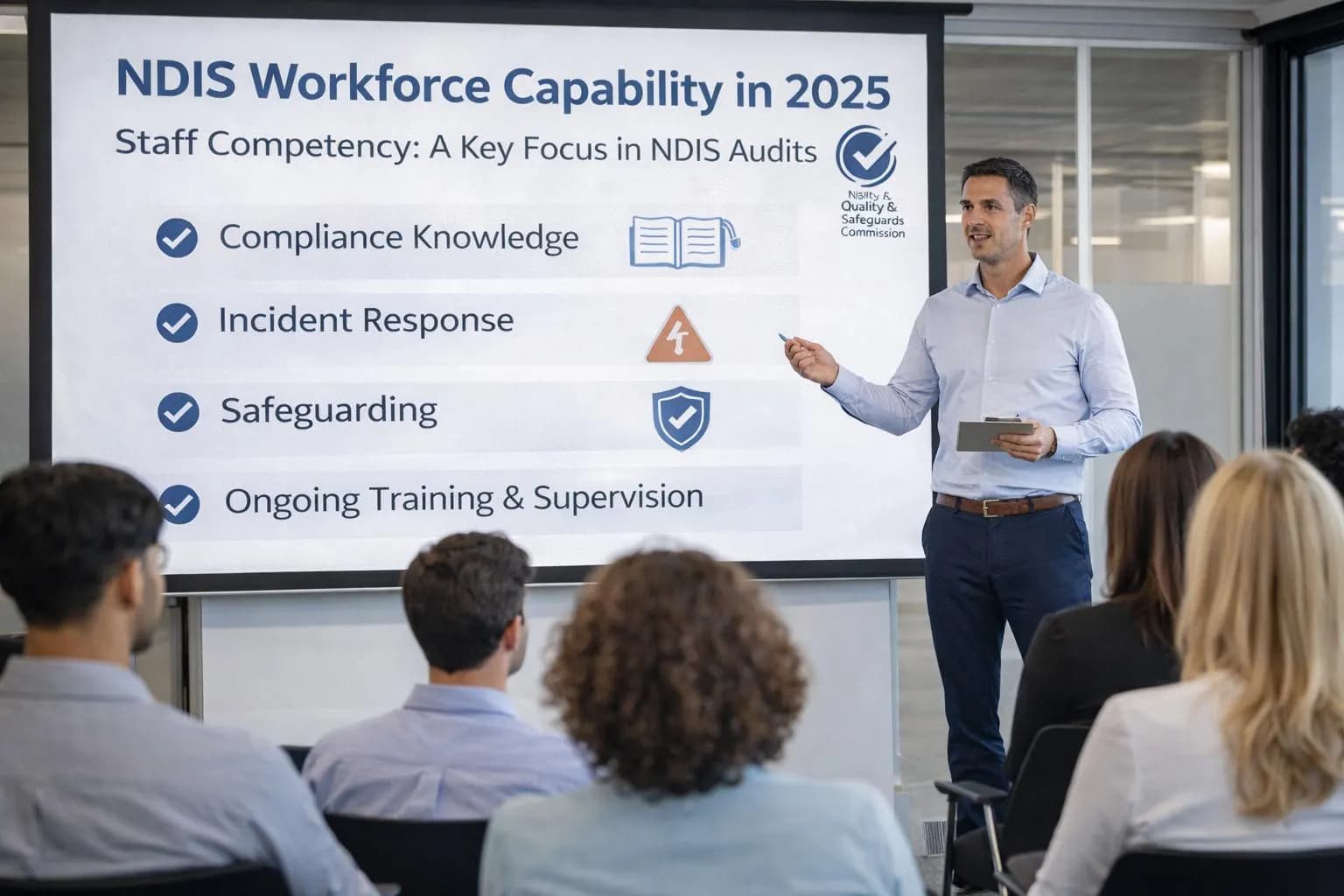
The short version: workforce capability under the NDIS is not a general expectation. It is a set of written requirements. The Human Resource Management standard in the Practice Standards lists ten indicators, from position descriptions to secondary-employment records. The Worker Screening Rules set out which roles need a clearance and exactly what you must record about them. The NDIS Code of Conduct binds every worker you engage. This guide walks through each one and the record that shows you meet it. Every requirement links to its source on the Federal Register of Legislation so you can check it.
What the standard requires
The Human Resource Management outcome in the NDIS (Quality Indicators for NDIS Practice Standards) Guidelines 2018 reads:
"Each participant's support needs are met by workers who are competent in relation to their role, hold relevant qualifications, and who have relevant expertise and experience to provide person-centred support."
It sits in the Governance and Operational Management division of the Core Module. The Verification Module carries the same outcome with five shorter indicators: identity, right to work and pre-employment records; the mandatory orientation module and continuing professional development; and infection control and PPE training. If you are new to how outcomes and indicators fit together, start with our explainer on the NDIS Practice Standards.
The outcome is tested through ten quality indicators. Read together, they describe a workforce file, not a training calendar.
1. Every position is defined
Indicator 1: "The skills and knowledge required of each position within a provider are identified and documented together with the responsibilities, scope and limitations of each position."
The record that shows it is a position description for every role, including casual and agency roles. "Scope and limitations" is the part most often left out. A support worker's description should say what the worker does not do (administer medication without training, for example) as clearly as what they do.
2. Pre-employment checks and worker screening
Indicator 2 requires that "records of worker pre-employment checks, qualifications and experience are maintained". For most providers, the heaviest part of this is worker screening, which has its own instrument: the NDIS (Practice Standards—Worker Screening) Rules 2018.
Identify your risk assessed roles
Section 11 requires a registered provider to assess all roles undertaken by workers and personnel in providing supports, and identify which are risk assessed roles. Under the definition in section 5, a risk assessed role is:
- a key personnel role;
- a role whose normal duties include the direct delivery of specified supports or services to a person with disability; or
- a role whose normal duties are likely to require more than incidental contact with a person with disability.
Section 13 then provides that, subject to limited exceptions, a provider "must only allow a worker to engage in a risk assessed role, if the worker has a clearance".
Keep the two lists the Rules require
A list of risk assessed roles (section 17). For each role: its title, which paragraph of the definition applies, a description, the date it was assessed and the name and title of the person who assessed it. The list must be updated within 20 business days of a new risk assessed role being identified or an existing role being reclassified.
A list of workers in those roles (section 18). For each worker: full name, date of birth and address, the role or roles they work in, and their NDIS worker screening application number, check number, outcome and any expiry date. Where an exception lets someone start before a clearance, the list records the exception, its start and end dates and, where supervision is required, who supervises them. The list must be kept up to date.
Section 20 sets the standard those lists are held to: the worker list must be kept "in a form which would allow an auditor to determine which workers were engaged in risk assessed roles with the provider on any given day in the seven years prior". Section 21 requires records to be kept for 7 years. A spreadsheet that is overwritten each time someone leaves does not meet that test. A dated history does.
3. Orientation, induction and the Code of Conduct
Indicator 3: "An orientation and induction process is in place that is completed by workers including completion of the mandatory NDIS worker orientation program."
The program is the Commission's worker orientation module, "Quality, Safety and You". Keep the completion certificate the module issues on each worker's file, alongside a record of your own induction: who inducted them, when, and what it covered.
Induction is also where workers meet the NDIS Code of Conduct. Section 5 of the Code of Conduct Rules makes it binding on NDIS providers and on "persons employed or otherwise engaged by NDIS providers", registered or not, and compliance is a civil penalty provision under section 73V of the NDIS Act. Section 6 requires a worker, in providing supports, to:
- act with respect for individual rights to freedom of expression, self-determination and decision-making;
- respect the privacy of people with disability;
- provide supports and services in a safe and competent manner, with care and skill;
- act with integrity, honesty and transparency;
- promptly take steps to raise and act on concerns about matters that may impact the quality and safety of supports;
- take all reasonable steps to prevent and respond to all forms of violence against, and exploitation, neglect and abuse of, people with disability; and
- take all reasonable steps to prevent and respond to sexual misconduct.
An induction that only hands over a copy of the Code proves less than one that walks through each element against the worker's actual role, and records that it did.
4. A training system, not a list of courses
Indicator 4 requires "a system to identify, plan, facilitate, record and evaluate the effectiveness of training and education for workers". The system must identify which training is mandatory, and include training on staff obligations under the Practice Standards and other NDIS rules. Indicator 9 adds that infection prevention and control training, "including refresher training, is undertaken by all workers involved in providing supports to participants".
The word that matters is evaluate. Attendance records show training happened; they do not show it worked. We cover how to design and evidence training in our guide to NDIS compliance training.
5. Supervision and performance
Indicator 5: "Timely supervision, support and resources are available to workers relevant to the scope and complexity of supports delivered." Indicator 6: "The performance of workers is managed, developed and documented, including through providing feedback and development opportunities."
Both are judged on records. Supervision notes with dates, a schedule that matches the complexity of the supports (a worker delivering complex behaviour support needs more than one delivering domestic assistance), and documented performance conversations are what demonstrate these two indicators.
6. Emergency workforce and worker details
The last three indicators deal with emergencies and with worker details:
- Indicator 7: workers with capabilities relevant to responding to an emergency or disaster, "such as contingency planning or infection prevention or control", are identified.
- Indicator 8: plans are in place "to identify, source and induct a workforce in the event that workforce disruptions occur in an emergency or disaster".
- Indicator 10: for each worker, contact details and details of any secondary employment are recorded and kept up to date.
Indicator 10 is easy to miss and cheap to meet: one field on the worker file, reviewed at each supervision.
The workforce file, indicator by indicator
| Requirement | Record that shows it |
|---|---|
| Indicator 1: positions defined | Position description per role, with scope and limitations |
| Indicator 2 and Worker Screening Rules s17–18 | Pre-employment checks, qualifications, the risk assessed roles list and the worker list |
| Worker Screening Rules s20–21 | Dated history of who held which role, kept 7 years |
| Indicator 3: orientation and induction | Orientation module certificate and signed induction record |
| Code of Conduct Rules s5–6 | Induction content covering each element of the Code |
| Indicators 4 and 9: training | Training needs analysis, mandatory training matrix, completion and evaluation records, infection control refreshers |
| Indicators 5 and 6: supervision and performance | Supervision notes and performance reviews |
| Indicators 7 and 8: emergencies | Emergency capability register and surge workforce plan |
| Indicator 10: worker details | Current contact details and secondary employment |
Check your own workforce file
Pick three workers at random and try to produce, for each, everything in the right-hand column above. Then take any date in the past year and work out from your records who was in each risk assessed role that day. Where either exercise stalls, you have found the gap before anyone else does.
Workforce records are one division of a wider picture. Our NDIS compliance checklist covers every division of the Core Module, with the evidence for each, and the related evidence for incidents is set out in our guide to getting reportable incidents right.
If you would rather build the training side with help, our compliance training service designs role-based programs and the records that evidence them.
Get NDIS compliance updates
Practical guidance on registration, audits and the 2027 wave. No spam, unsubscribe in one click.